

Yeast infections
Is it safe to have sex with a yeast infection?

Zineb Sadki
Editorial writing, Santelle
Are you experiencing itching, burning, and persistent discomfort that just won't go away? You might be wondering if it is still okay to have sex. This is a very common and completely understandable question.
The direct answer: yes, it is technically possible, but it is generally not recommended.
Not because it is dangerous, but because it can worsen your symptoms, delay healing, and, in some cases, pass the yeast infection to your partner.
In this article, we explain everything you need to know to make the best decision for your body.

What is a vaginal yeast infection?
A vaginal yeast infection is a fungal infection caused, in the vast majority of cases, by a yeast called Candida albicans. This yeast is naturally present in the vagina in small amounts.
When the natural balance of your vaginal flora is disrupted, the yeast multiplies, leading to an infection with highly recognizable symptoms.
It is one of the most common vaginal infections: it is estimated that three out of four women will experience at least one in their lifetime.
Contrary to popular belief, it can easily occur without any sexual contact, often triggered by antibiotics, pregnancy, diabetes, stress, or even using products that irritate the area.
Symptom | What it feels like |
|---|---|
Itching | Intense, especially at the end of the day or during the night |
Burning | Around the vulva, which feels worse when urinating |
Vaginal discharge | Thick, white, with a cottage cheese-like appearance |
Redness and swelling | The vulvar area is visibly inflamed, red, and tender |
These symptoms can vary in intensity from person to person.
Some women only feel mild discomfort, while others go through a very painful episode that disrupts their daily life.
What are the risks of having sex during a yeast infection?
While having sex during a yeast infection is not strictly forbidden, several practical risks make it highly unadvisable.
Increased pain and irritation
The vaginal tissues are already inflamed and extremely sensitive during a yeast infection. The friction from intercourse will mechanically worsen this irritation.
What was manageable during the day can become highly painful during or after sex.
Burning and itching are likely to increase in the hours that follow. For many women, the experience is simply too uncomfortable to consider.
Delayed healing
Your body needs rest to heal and regenerate sensitive tissues. Putting friction on them while they are already fragile can make the infection last several days longer.
Additionally, some vaginal suppositories (pessaries) can be partially displaced or less effectively absorbed after sex, reducing the strength of your treatment.
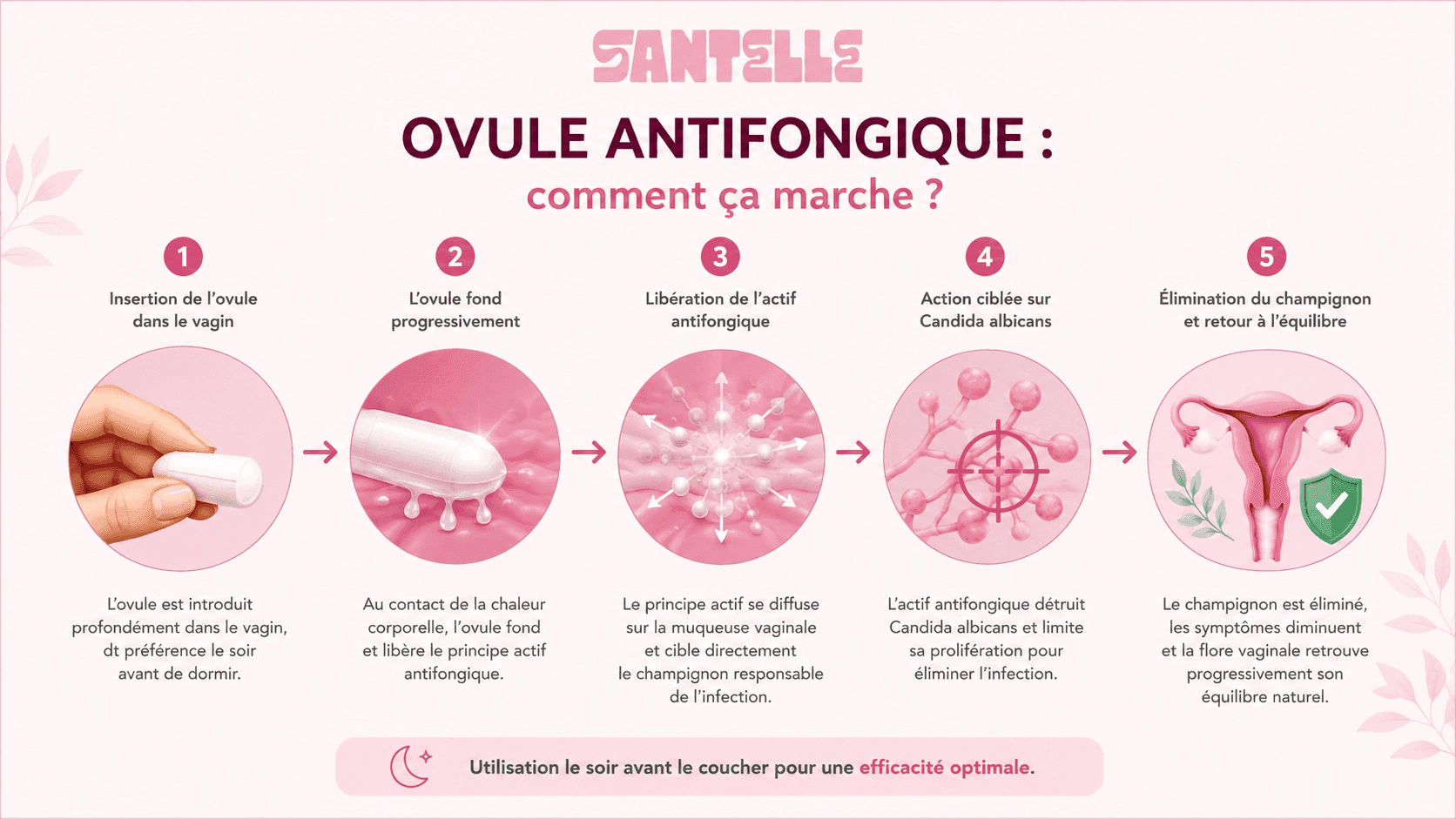
If you want to clear up the yeast infection as quickly as possible, giving your body a break from sexual activity is undoubtedly your best option.
Risk of passing the infection to your partner
A vaginal yeast infection is not classified as a sexually transmitted infection (STI), as it can occur without any sexual contact.
However, the Candida albicans yeast can sometimes be passed on during intimate contact, even if it does not happen every time.
To limit this risk, it is best to wait until you are fully healed before having sex again.
Can my partner catch my yeast infection?
Men can catch a Candida albicans infection, but they develop symptoms much less frequently.
Their anatomy naturally offers better protection against these infections.
When symptoms do appear, it is known as candidal balanitis. A male partner might experience:
Redness and irritation on the head of the penis (gland)
Localized itching, sometimes with small white patches
A slight burning sensation when urinating
General discomfort in the affected area
If your partner has these symptoms, they also need to be treated. Otherwise, you risk passing the infection back and forth once you resume sexual activity—this is known as the "ping-pong" effect and is a common cause of recurring infections.
If they do not have any symptoms, treatment is generally not necessary.
However, if you suffer from recurrent yeast infections, your doctor may recommend treating both partners as a preventive measure.
Can you have protected sex during a yeast infection?
Using a condom is often considered a middle-ground solution. It does lower the risk of passing the yeast to your partner by creating a physical barrier.
This is a helpful step if you really want to have sex.
However, it does not stop your discomfort: you are still likely to feel the pain and irritation caused by the inflammation.
Furthermore, certain lubricants or condom materials can actually worsen the irritation.
Avoid scented condoms or those with additives. Keep in mind that letting your tissues rest remains the most reliable way to heal quickly and avoid complications.
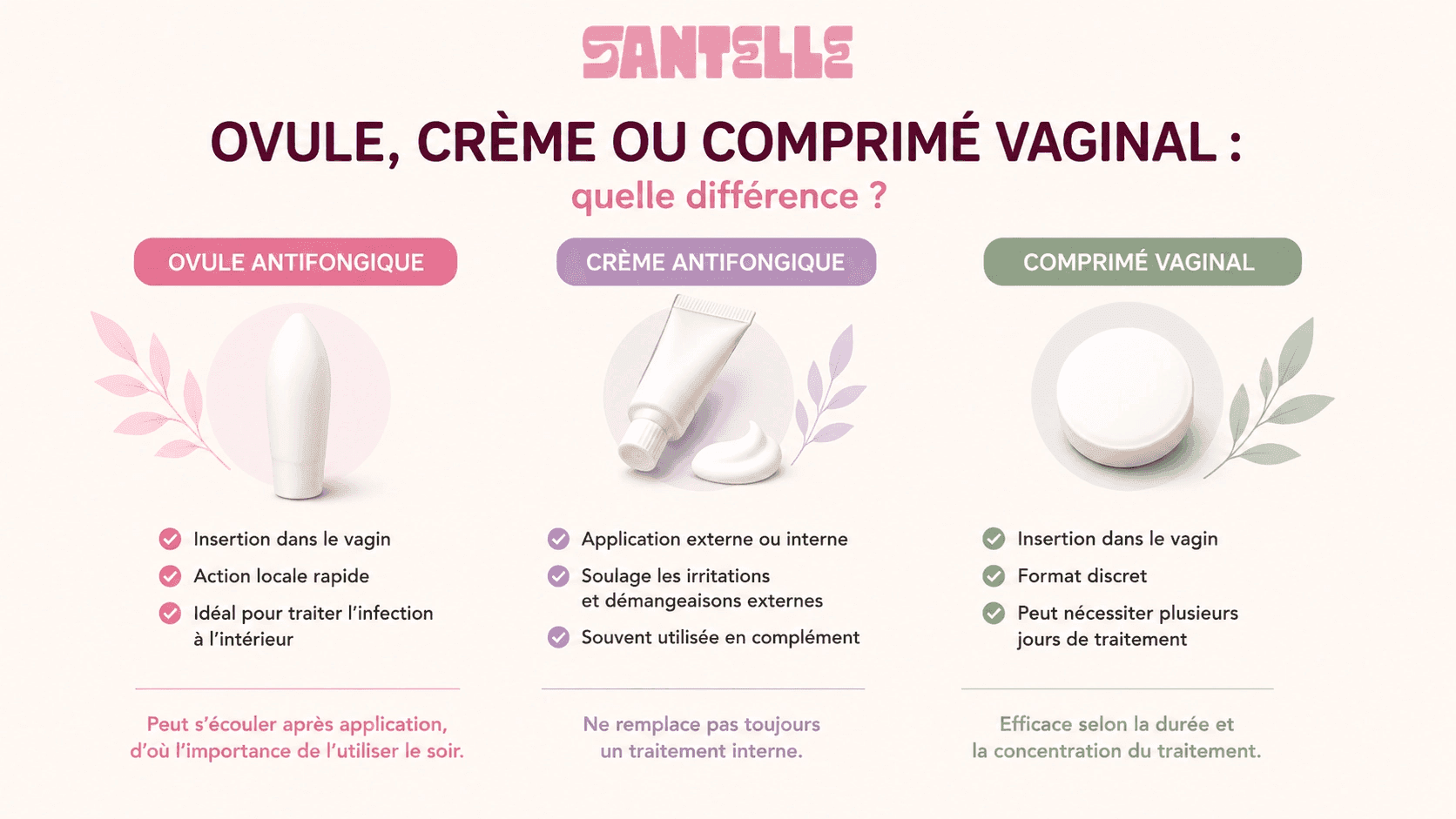
Cremes, vaginal suppositories, or tablets: which treatment should you choose?
When dealing with a yeast infection, the many options at the pharmacy can feel overwhelming. A 1-day or 7-day treatment? Cream or tablet? Over-the-counter or prescription? Here is a simple guide to help you choose.
Treatment | Type | Duration | Prescription | Best for |
|---|---|---|---|---|
Vaginal suppository (pessary) | Local (vaginal) | 1 to 7 days | No (over-the-counter) | First-time infections, pregnancy |
Antifungal cream | Local (vulvar/external) | 5 to 7 days | No (over-the-counter) | Using alongside vaginal suppositories |
Oral tablet (fluconazole) | Oral | Single dose | Yes (under medical guidance) | Repeat infections, severe external discomfort |
Vaginal Suppositories (Pessaries)
This is the standard treatment for a vaginal yeast infection, recommended first by the vast majority of doctors and gynecologists.
The suppository is inserted high into the vagina, ideally at bedtime, to minimize leakage and allow the active medicine to work overnight.
How does it work?
The suppository contains an antifungal medicine that directly targets the Candida albicans yeast causing the infection.
It breaks down the yeast's outer wall, stopping it from growing. Once inserted, it slowly dissolves in the vagina, sending out the medicine continuously over several hours for long-lasting relief.
Common active ingredients
Clotrimazole (Canesten, Gyno-Lotrimin): The most widely used option, known for being very well tolerated.
Econazole (Gyno-Pevaryl): Highly effective and available in various course lengths (1, 3, or 15 days) to suit different needs.
Miconazole (Monistat, Daktarin): Often bundled with an external cream to treat itching on both the inside and outside.
Fenticonazole (Lomexin): Available as a high-strength single-dose capsule for quick, convenient treatment.
Practical tips for best results
Insert the suppository at night just before going to sleep, while lying down with your knees bent.
Use the provided applicator to make insertion smooth and comfortable.
Wear a panty liner rather than a tampon during treatment so you do not absorb the medicine away from where it is needed.
Do not stop your treatment if your period starts; continue using it as normal.
Always finish the full course, even if your symptoms go away after a couple of days. Stopping early can cause the infection to come back.
Antifungal Cream
Antifungal cream is designed to support your vaginal treatment, not replace it entirely.
It is applied to the vulva and outer lips to soothe external itching and burning.
When should you use it?
Alongside a vaginal suppository: to treat both internal and external symptoms at the same time
When external itching is very intense and you need quick relief
To treat candidal irritation on a male partner's penis
How should you apply it?
Apply a small amount to the outer area 2 to 3 times a day
Always wash your hands before and after applying
Do not use this cream inside the vagina—that is what vaginal suppositories are for
Keep applying it for a few days even after your symptoms disappear
These creams generally contain the same active ingredients as suppositories (such as clotrimazole, econazole, or miconazole) and are available over-the-counter.
Oral Antifungal Tablets
The standard oral treatment is a single dose of fluconazole 150 mg. It is a system-wide antifungal pill taken by mouth. Its effectiveness is comparable to treatments applied directly to the vagina.
Benefits of oral tablets
Single dose: highly convenient, with no messy creams or suppositories to insert
Works from the inside out: helpful for symptoms that are hard to treat with creams alone
Useful for treating recurrent infections under medical supervision
Unlike creams and suppositories, oral tablets will not damage condoms
Limitations and precautions
May require a prescription depending on your local regulations
Not recommended during pregnancy (local vaginal treatments are preferred instead)
Can interact with other medications (like blood thinners or certain antibiotics)
Symptoms can still take 2 to 3 days to fully clear up after taking the single dose
Not suitable for everyone: talk to your healthcare professional first
How to choose the best treatment for you
Your Situation | Recommended Treatment |
|---|---|
First time, mild symptoms | 1-day or 3-day over-the-counter vaginal suppository |
Moderate to severe symptoms | 6-7 day vaginal suppository + external cream |
Pregnancy | Vaginal suppositories only (avoid oral fluconazole) |
Severe external irritation | Oral fluconazole tablet (by prescription/pharmacist advice) |
Frequent repeat infections | Oral tablet + medical consultation required |
Partner treatment | Antifungal cream applied to the head of the penis |
During your period | Continue with your vaginal suppository without stopping |
If you are unsure which treatment to choose, or if this is your first infection, ask your pharmacist or doctor for advice.
When is it safe to have sex again after a yeast infection?
Yeast infections usually clear up within a few days. The break from sex is short, but it is important to stick to it to prevent the infection from coming back.
Before resuming sex, make sure you meet these 3 conditions:
All itching and burning have completely stopped
Irritation and unusual discharge are completely gone
Your antifungal treatment is fully finished, even if you felt better before the end
If you used a vaginal suppository, wait until the product has fully dissolved and all discomfort is gone before having sex.
How to prevent a yeast infection from coming back
Frequent infections can be exhausting and can really impact your daily life, including your relationships.
If this is happening to you, our guide on recurrent vaginal infections can help you understand why they return and how to break the cycle.
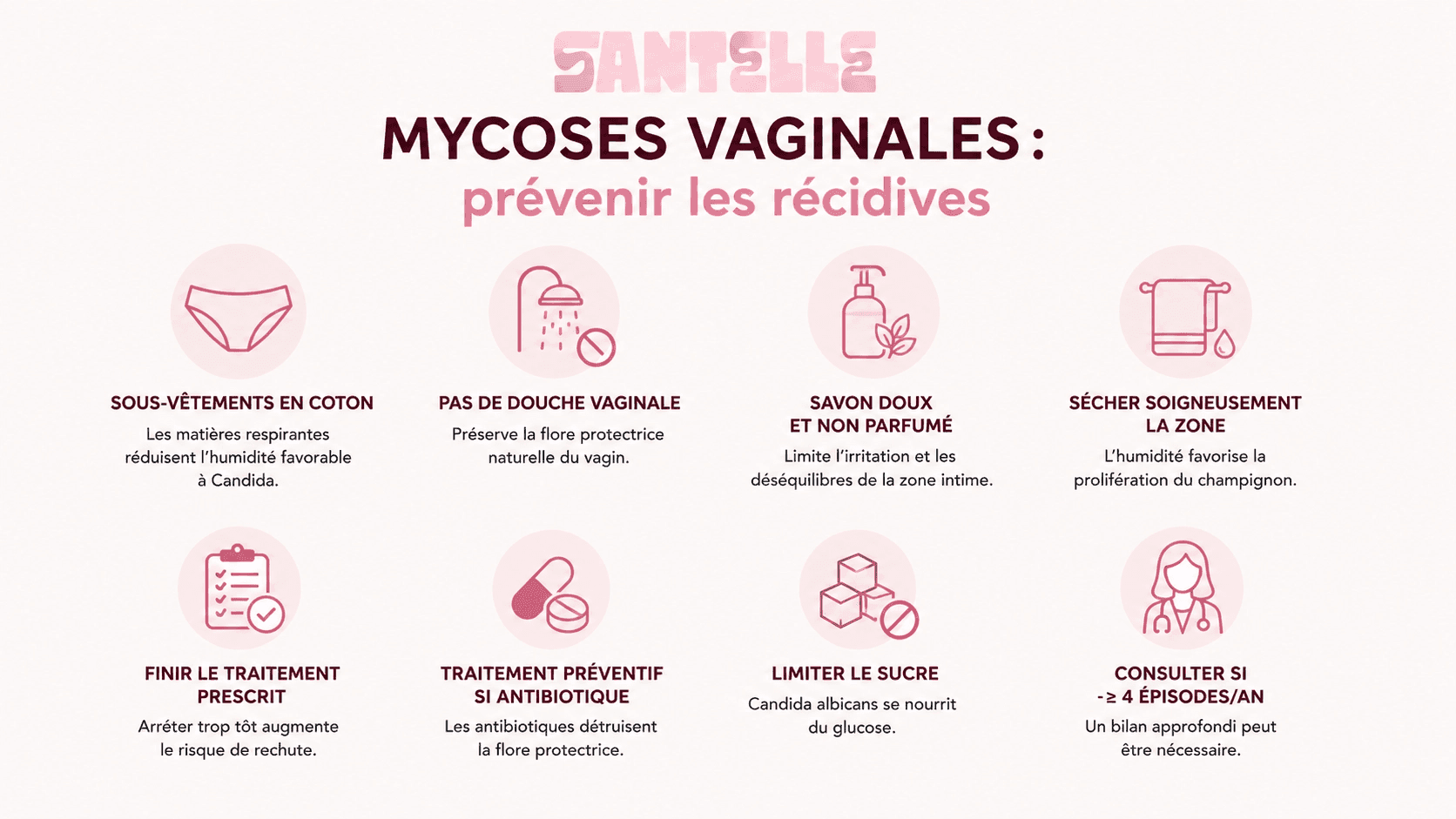
In any case, adopting a few simple habits can greatly lower your risk of another infection.
Healthy Habit | Why it helps |
|---|---|
Wear cotton underwear | Breathable fabrics reduce the moisture warmth that yeast loves |
Avoid douching | Protects the natural, healthy balance of your vagina |
Use mild, unscented soap | Limits irritation and avoids upsetting your natural pH |
Dry the area thoroughly | Moisture left behind creates the perfect environment for yeast to grow |
Complete your full treatment | Stopping too early makes a speedy relapse much more likely |
Preventive care with antibiotics | Antibiotics kill good bacteria, allowing yeast to grow out of control |
Limit high-sugar foods | Candida albicans thrives on sugars in the body |
See a doctor for 4+ episodes/year | A specialized treatment plan or further health checks may be needed |
These daily adjustments do not guarantee you will never get another infection, but they significantly reduce how often they happen for women who are prone to them.
Frequently Asked Questions (FAQ)
Is a yeast infection a sexually transmitted infection (STI)?
No. A vaginal yeast infection is not classified as an STI. It can occur without any sexual contact, often triggered by antibiotics, hormonal changes, or a temporary dip in immune health.
However, the yeast can sometimes be passed during intimate contact, which is why taking a short break from sex during treatment is a smart choice.
Can you get a yeast infection if you have never had sex?
Absolutely. Candida albicans naturally lives in the vagina of most women. An overgrowth can happen completely independently of sexual activity.
Young girls who have never been sexually active can easily get yeast infections, especially after taking antibiotics or during times of high stress.
Can birth control pills cause yeast infections?
Yes, they can. Hormonal contraceptives can change the environment in the vagina by increasing glycogen levels, which yeast feeds on. Some women notice they get yeast infections more often after starting the pill.
If you suspect this is happening to you, talk to your doctor to explore other contraceptive options that might suit you better.
How long does treatment take?
It depends on what treatment you use. Vaginal suppositories are used for 1 to 7 days depending on their strength. An oral fluconazole tablet is taken as a single dose, though symptoms may still take a couple of days to clear up. You will usually feel much better within 2 to 3 days.
No matter the treatment, always finish the course as directed.
Can a yeast infection return right after sex, even if I was healed?
Yes. If your partner was carrying the yeast without realizing it, or if your vaginal environment is still sensitive and recovering, an immediate flare-up can occur.
This is why it is highly recommended to wait a few days after finishing your treatment and ensuring all symptoms are completely gone before having sex again.
What should I do if my yeast infections keep coming back?
If you experience four or more yeast infections in a year, it is considered chronic or recurrent. When this happens, simple over-the-counter creams or suppositories are often not enough.
You should see a doctor or gynecologist to identify what is triggering the infections, check your vaginal flora, and discuss a personalized, long-term treatment plan.
Frequently asked questions
Is a yeast infection a sexually transmitted disease?
No. A vaginal yeast infection is not classed as an STI. It can appear with no sexual contact at all, triggered by antibiotics, a hormonal imbalance or lowered immunity. That said, the fungus responsible can sometimes be passed on through intimate contact, which is why caution and rest during treatment make sense.
Can you get a yeast infection if you have never had sex?
Absolutely. Candida albicans is naturally present in the vagina in most women. Overgrowth can happen independently of any sexual activity. Young women who have never had intercourse can certainly develop a yeast infection, particularly after taking antibiotics or during a peak of stress.
Can the contraceptive pill cause yeast infections?
Yes. Hormonal contraceptives change the vaginal environment by increasing glycogen levels, which Candida feeds on. Some women notice more frequent yeast infections since starting the pill. If that is your case, talk to your doctor: there are contraceptive alternatives worth exploring depending on your profile.
How long does treatment last?
It depends on the treatment. Vaginal pessaries are used over 1 to 7 days depending on the concentration of the active ingredient. Oral fluconazole works in a single dose, even if symptoms take a few days to clear. A clear improvement is often visible within 2 to 3 days. In every case, always complete the full course you were prescribed.
Can a yeast infection come back after sex, even once it has cleared?
Yes. If your partner was carrying Candida without knowing, or if your vaginal flora is still fragile right after treatment, a relapse is possible. That is why it is advisable to wait a few full days after the end of treatment and the complete disappearance of symptoms before resuming sex.
What should you do if yeast infections keep coming back?
If you have more than four episodes a year, this is called chronic or recurrent thrush. In that case a simple cream or pessary is not enough. You need to see a doctor or gynaecologist to identify the triggers, assess the balance of your vaginal flora and consider a longer-term treatment suited to your situation.
Written by
Zineb Sadki
Editorial writing, Santelle
Zineb writes and edits the Santelle blog, on intimate health and the vaginal microbiome.