

Symptoms
Vaginal irritation: causes, how to recognise it and what to do

Zineb Sadki
Editorial writing, Santelle
It burns, it itches, and there is that feeling of discomfort you simply cannot ignore.
Vaginal irritation can appear without warning and disrupt your daily life, sometimes with no apparent reason. Before worrying or rushing to the pharmacy, it helps to understand what is actually going on.
In this article we review the main causes of an irritated vagina, help you tell simple irritation from an infection, and give you concrete steps to relieve and prevent it. Because understanding what is happening in your body is already half the journey.
What is vaginal irritation?
Vaginal irritation is simply the reaction of the skin or mucous membranes to something that aggravates or unbalances them.
It shows up as itching, burning, redness, or a feeling of dryness.
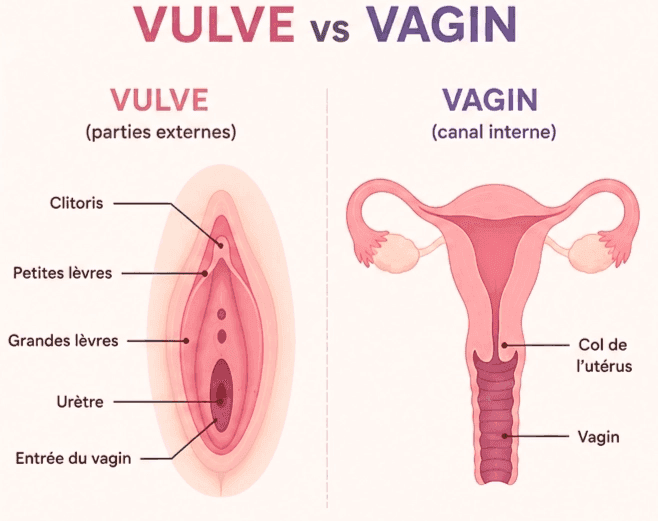
A quick anatomical point: many women use the word "vagina" for the whole genital area, but the vagina is in fact the internal canal, while the vulva refers to the external parts (labia, clitoris, vaginal opening).
In practice, irritation often affects both at once, and the distinction matters little to how it feels day to day.
The key point: irritation is a symptom, not a disease in itself.
It signals that something is disturbing the balance of the area, whether an irritating product, an imbalance of the flora, or the start of an infection.
What are the signs of vaginal irritation?
What many people do not know is that these signs rarely appear alone, and that they vary with the underlying cause.
The most common are:
Persistent discomfort, a diffuse unease often worse when sitting or during exertion
Itching (pruritus), which typically intensifies in the evening or at night
Redness and slight swelling of the vulvovaginal mucous membrane
Unusual discharge, coloured (yellow, grey, greenish), with a changed odour or consistency
A burning feeling when urinating or during sex
What causes vaginal irritation?
This is often the most useful question to ask. The causes are varied, and identifying them leads you to the right solution.
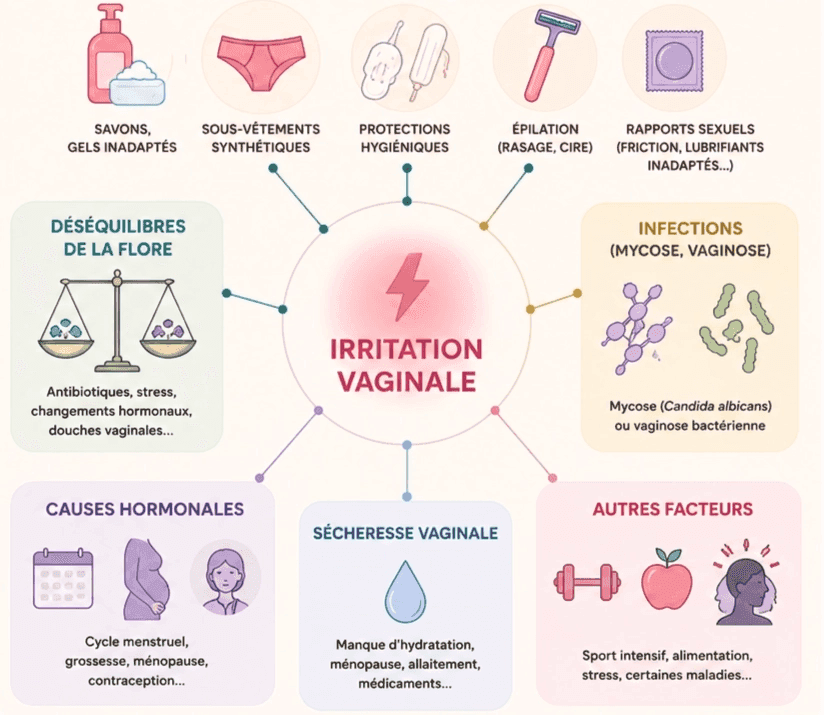
External irritants
The body sometimes reacts to everyday things you would not necessarily suspect:
Soaps and washes: the vaginal mucous membrane is very sensitive. A soap that is too perfumed or too alkaline, or an unsuitable intimate gel, can be enough to trigger a reaction. Water is enough for the internal area; for the vulva, a product with a suitable pH (between 4 and 5) is preferable.
Synthetic underwear: nylon, polyester and synthetic lace trap moisture and heat, fertile ground for irritation. Cotton remains your best ally.
Sanitary protection: pads, tampons or panty liners that are perfumed or contain additives can irritate. Fragrance-free products, or alternatives such as a menstrual cup or period underwear, are often better tolerated.
Hair removal: shaving or waxing can cause micro-cuts, ingrown hairs and redness. Post-hair-removal irritation is common and generally temporary.
Sex: friction, unsuitable lubricants, condoms with spermicide, latex (if you are allergic), all possible factors. Insufficient lubrication is also a common cause of burning after sex.
Imbalances of the vaginal flora
The vagina hosts a delicate bacterial ecosystem, dominated by lactobacilli, which maintain a protective acidic pH. This is what we call Döderlein flora.
When that balance is disturbed, irritation can set in quickly.
Several factors can destabilise it:
Antibiotics, which destroy the good bacteria along with the bad
Stress, which acts on hormones and can change the vaginal environment
Hormonal changes (menstrual cycle, pregnancy, menopause)
Douching, which removes the protective flora. It should be avoided completely
Infections (yeast infection, vaginosis)
Irritation can be the first sign of an infection. The two most common are:
Vaginal yeast infection (candidiasis), caused by a fungus, Candida albicans. It causes intense itching, burning, and sometimes thick white discharge.
Bacterial vaginosis, linked to an imbalance of the flora. Quieter than a yeast infection, it shows up mainly as grey or greenish discharge with a characteristic fishy odour.
The problem: it is hard to tell simple irritation from an infection without a test.
The symptoms resemble each other, and choosing the wrong treatment (for example using an antifungal when it is vaginosis) is not only ineffective, it can make the imbalance worse.
If in doubt, a quick vaginal test, available at the pharmacy or from a doctor, settles the question.
Hormonal causes
Hormones play a direct role in the hydration and elasticity of the vaginal mucous membranes. When they fluctuate, discomfort can follow:
Before your period, the drop in oestrogen can cause dryness and increased sensitivity.
During pregnancy, hormonal changes alter vaginal pH and make the area more reactive.
At menopause, the lasting fall in oestrogen often leads to chronic vaginal dryness, sometimes with irritation and pain during sex. This is what we call vulvovaginal atrophy.
To learn more about the links between hormones and vaginal discharge, we go into detail in this article.
Vaginal irritation or infection: how do you tell the difference?
This is often the big question, and a good one, because the answer completely changes what you should do.
Simple irritation | Yeast infection | Vaginosis | |
|---|---|---|---|
Itching | ✓ strong | ✓ very strong | mild |
Discharge | normal | white, thick | grey, thin |
Odour | none | slight | fishy |
Burning | possible | ✓ | rare |
Duration | 1-3 days | persists | persists |
These three problems resemble each other but are told apart by a few key signs:
Simple irritation: strong itching, no abnormal discharge, no odour. Clears in 1 to 3 days.
Yeast infection: very intense itching, thick white discharge, slight burning. Persists without treatment.
Vaginosis: grey, thin discharge with a fishy odour, mild itching. Persists without treatment.
In practice: if the symptoms disappear within 2 to 3 days after removing the cause (changing soap, wearing cotton, and so on), it was probably simple irritation.
If they persist or intensify, an infection should be considered and a test or consultation is needed.
What should you do about vaginal irritation?
Faced with vaginal irritation, the right reflexes make all the difference. Depending on the cause, temporary irritation, yeast infection or vaginosis, the solutions are not the same.
Here are the main options for relieving symptoms and avoiding common mistakes.
Immediate steps
Identify and remove the likely cause: change soap, stop using an irritating sanitary product, avoid sex for a few days if that is when it started.
Wash gently: lukewarm water only on the internal area, a product with a suitable pH for the vulva.
Wear cotton underwear and avoid tight clothing that encourages heat and moisture.
Do not scratch: it makes the inflammation worse and risks creating micro-lesions.
Avoid douching: it disturbs the flora even further.
Natural remedies
A few options can help calm mild irritation:
Pure aloe vera gel (free of alcohol and fragrance) applied to the vulva can reduce inflammation.
Oral probiotics containing lactobacilli can support the rebalancing of the flora, particularly after taking antibiotics.
Gentle plant-oil emollients (such as coconut oil or calendula oil) can relieve vulval dryness, for external use only.
What to avoid: plain yoghurt applied locally (popularised online), pure undiluted essential oils, and any product containing alcohol or menthol.
Medical treatments
Antifungals (cream or pessary) for a yeast infection, available without a prescription (e.g. econazole, clotrimazole)
Antibiotics for vaginosis, on medical prescription only
Vaginal probiotics to rebalance the flora, particularly after a course of antibiotics
Medical treatments are effective but must always match the cause. Medical advice remains the best guarantee of targeted, risk-free treatment.
When should you see a doctor?
The vast majority of vaginal irritations resolve within a few days with no medical intervention. But some signals should alert you:
The symptoms persist for more than 5 to 7 days without improving
There is abnormal discharge (unusual colour, texture or odour)
A fever or pelvic pain appears
The symptoms come back regularly (more than 3 times a year)
You are pregnant
In these cases, a consultation identifies precisely where it comes from and adapts the treatment.
A vaginal swab or a rapid test can be done easily and gives a clear answer.
Conclusion
Vaginal irritation is common, often harmless, and in most cases linked to an external irritant or a temporary imbalance.
Identifying the cause, whether a soap that is too harsh, a hormonal fluctuation or the first signs of an infection, is the key to responding effectively.
If the symptoms disappear quickly once you remove the likely cause, there is no need to worry.
If it persists, however, if the discharge changes or if the pain intensifies, a medical consultation remains the safest way forward. Taking care of your intimate health is above all about learning to listen to what your body is saying, without playing it down and without dramatising it.
Frequently asked questions
How do you treat irritation of the intimate parts?
Start by removing the likely cause (irritating soap, tight clothing, unsuitable hygiene product). A fragrance-free soothing cream is often enough for simple irritation. If symptoms last more than 3 days, seek advice.
Which cream should you put on an irritated vulva?
A zinc oxide cream or a fragrance-free moisturising cream to calm the inflammation. With a confirmed yeast infection, a local antifungal (econazole, clotrimazole) is recommended.
How does a vulval yeast infection start?
With gradual itching, mild at first then very intense, accompanied by redness. Thick white discharge appears next.
Why is my intimate area irritated?
The causes are many: soap that is too harsh, friction, hormonal imbalance, fungal or bacterial infection, allergy to a product (condom, wipe, panty liner).
What is the best cream for irritation of the intimate parts?
There is no universal cream, it all depends on the cause. For simple irritation, choose a fragrance-free soothing cream. For a yeast infection, an antifungal. Ask a pharmacist for advice if you are unsure.
How long does genital skin irritation last?
Simple irritation clears in 1 to 3 days with the right care. Beyond that, a yeast infection or vaginosis is likely and needs suitable treatment.
What causes vulval irritation without a yeast infection?
It can come from mechanical friction, a contact allergy, hormonal vaginal dryness, or bacterial vaginosis. Irritation with no abnormal discharge or odour is often external in origin.
What are the signs of a genital infection in women?
Unusual discharge (coloured, smelly), burning when urinating, pelvic pain, persistent itching. With a fever or intense pain, seek advice quickly.
What does the start of a fungal infection look like?
Mild itching that quickly intensifies, redness around the vulva, then thick white discharge appearing. Symptoms often get worse at night.
Written by
Zineb Sadki
Editorial writing, Santelle
Zineb writes and edits the Santelle blog, on intimate health and the vaginal microbiome.