

Symptoms
Vaginal pain: why does it hurt and what can you do?

Yasmina Akni
Press relations and writing, Santelle
Vaginal pain can take many forms: burning, itching, sharp twinges, pain during sex, everyday discomfort.
Something many women feel, and far too few dare to name. This guide helps you identify where your vaginal pain comes from and understand what can be done about it.
Locating your pain: vulva, vestibule or vagina?
"Vaginal pain" can in fact involve several different areas: the vulva (the external, visible part), the vestibule (the vaginal opening), or the vagina itself (the internal canal).
The exact location of the pain is valuable information for your doctor. Start by noting where, how and in what circumstances it hurts.
Before identifying the cause, you first need to know exactly where the pain is. Doctors distinguish several areas, because they often correspond to different origins.
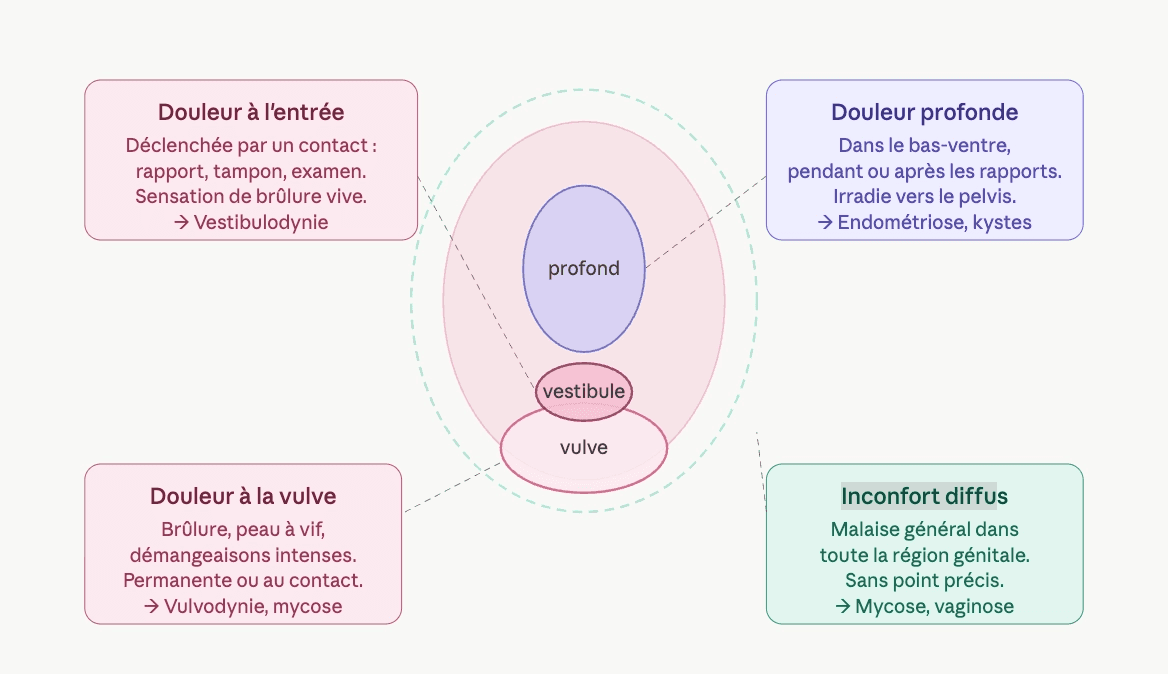
Pain in the vulva: burning, irritation or a feeling that the skin is raw around the labia majora and minora or the clitoris. It can be constant or triggered by contact.
Pain at the vaginal opening: pain localised to the vestibule, the entrance area of the vagina. Often triggered by penetration, inserting a tampon or a gynaecological examination.
Pain in the lower abdomen: felt deeply during sex, and able to radiate towards the pelvis. Often associated with endometriosis or ovarian cysts.
Pain that is hard to locate: general discomfort in the genital area, with no precise point. Often accompanies a yeast infection or bacterial vaginosis.
Infectious causes: the most common
The vast majority of occasional vaginal pain has an infectious origin.
These are the easiest to treat, provided the right agent is identified, which often requires a vaginal swab, not just a visual estimate of the symptoms.
Vaginal yeast infection
This is the most common cause of vaginal pain and burning. It is caused by the overgrowth of a fungus, Candida albicans, naturally present in the vagina in small quantities.
When it multiplies too much, after a course of antibiotics, during a stressful period, during pregnancy or with hormonal variations, it causes intense itching, burning and redness of the vulva.
The discharge is white and thick, with no particular odour. Three women in four will have at least one in their lifetime.
It is treated with local antifungals available in pharmacies, or with oral fluconazole on prescription, depending on the intensity of the symptoms.
Bacterial vaginosis
It results from an imbalance of the vaginal flora: the good protective bacteria lose ground to less benign bacteria. It is recognised above all by a characteristic fishy odour, stronger after sex.
The discharge is greyish or yellowish, thin and heavy. There is often little or no itching, and in some cases no symptoms at all. It is not an STI, but it recurs frequently.
Treatment is with antibiotics, on prescription only.
Trichomoniasis
This is an STI caused by a microscopic parasite, Trichomonas vaginalis. It causes intense vaginal irritation, burning when urinating and frothy yellow-green discharge with an unpleasant odour.
What sets it apart from other infections: both partners must be treated at the same time, even if one of them has no symptoms. Without that, reinfection is inevitable.
Bartholinitis
The Bartholin's glands are two small glands located either side of the vaginal opening. Their role is to provide lubrication during sexual arousal.
When their duct becomes blocked, a cyst forms, often painless as long as it does not become infected.
When it does become infected, that is bartholinitis. A throbbing, pulsating pain sets in at the vaginal opening, generally on one side only.
The area swells, becomes hot and tender. Some women find it hard to walk or sit.
If the infection develops into an abscess, surgical treatment is needed.
While waiting for the consultation, warm sitz baths several times a day can help relieve the discomfort.
Knowing how to locate your pain: vulva, vestibule or vagina?
Before identifying the cause, you first need to know exactly where the pain is.
Doctors distinguish several areas, because they often correspond to quite different origins.
Taking the time to note where, how and in what circumstances it hurts is valuable information for your doctor, and often points to the diagnosis even before the examination.
Vulvodynia: pain in the vulva (labia majora and minora, clitoris). Often described as burning or a feeling that the skin is raw. It can be constant or appear only on contact.
Vestibulodynia: pain localised to the vaginal opening, the most common form of vulvodynia. Almost always triggered by contact: sex, inserting a tampon, a gynaecological examination.
Deep pain: felt in the lower abdomen during or after sex. It does not come from the vaginal mucous membrane but from deeper structures, the uterus, ovaries, pelvic ligaments. It points to causes such as endometriosis or ovarian cysts.
Diffuse discomfort: general unease across the whole genital area, with no precise point. Often accompanies common infections such as a yeast infection or bacterial vaginosis.
Hormonal causes: when oestrogen is lacking
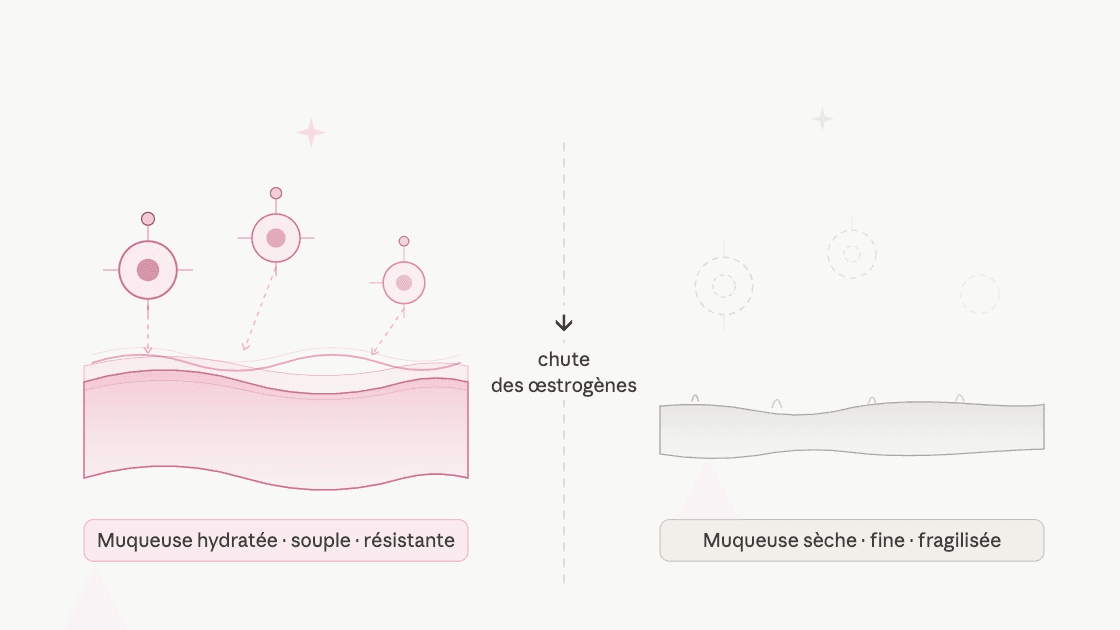
Oestrogen plays an essential role in vaginal health: it keeps the mucous membrane hydrated, supple and resilient.
When its level falls, pain and discomfort can set in gradually.
Vaginal dryness linked to menopause
This is the most widespread cause in women over 50. Without oestrogen, the vaginal walls thin and dry out.
The result: burning, itching, everyday discomfort, and often pain during sex.
This situation, called atrophic vaginitis, affects more than one woman in two after menopause, but remains underdiagnosed and undertreated because it is not talked about.
The postpartum period and breastfeeding
After giving birth, and especially while breastfeeding, oestrogen levels also drop.
Vaginal dryness and pain during sex are common in this period, and entirely normal.
They do not mean something is wrong, but they deserve attention and suitable solutions.
The contraceptive pill
Some progestogen-only or combined pills can change vaginal lubrication in some women, by reducing the level of available oestrogen.
If you have noticed vaginal dryness or pain during sex since starting a new pill, talk to your gynaecologist: changing contraceptive often resolves the problem.
Hormonal vaginal dryness responds very well to treatment: lubricants (for sex), vaginal moisturisers used regularly, or local oestrogen prescribed by your doctor for more significant forms.
Pain during sex
Pain during sex is not normal, and you do not have to accept it.
This pain, called dyspareunia, affects around 7.5% of sexually active women. It comes in two very different forms.
Type | Where the pain is | Common causes |
|---|---|---|
Superficial | At the vaginal opening, from the start of penetration | Vaginismus, vaginal dryness, recurrent yeast infection, vestibulodynia, episiotomy scar |
Deep | In the lower abdomen, at the end of penetration or afterwards | Endometriosis (the main cause), ovarian cysts, uterine fibroids, pelvic inflammatory disease |
Vaginismus
Vaginismus is an involuntary, reflex contraction of the perineal muscles that makes any penetration painful, or even impossible. It is not a question of willpower: the body contracts automatically.
It can be primary (always present) or secondary (appearing after a traumatic or painful event, or a long period without sex).
It responds very effectively to pelvic physiotherapy, sometimes combined with psychological support.
Endometriosis
If you have deep pain during sex, especially if it comes with painful periods, chronic pelvic pain or difficulty conceiving, endometriosis should be considered.
It is the cardinal sign of this condition, which is still often diagnosed several years late.
You need to raise it explicitly with your gynaecologist, even if you have already had tests that found nothing.
Tip:
Pain during sex is not part of a normal sex life. It is not inevitable. If it hurts, if you dread sex, if you avoid it, seek advice. Solutions exist for every cause.
When should you see a doctor?
Vaginal pain has this particularity: it is often played down, by women themselves, and sometimes by doctors too.
This guide has given you some keys for understanding what you feel. But understanding does not replace a diagnosis.
Seek advice within 24 to 48 hours if the pain comes with a fever, if you feel intense, sudden pelvic pain, if you are pregnant, or if you feel a painful, hot lump at the vaginal opening. These signs call for a prompt clinical examination.
Make an appointment in the coming days if this is your first episode. Treating blind can make the situation worse, especially bacterial vaginosis mistaken for a yeast infection.
Do the same if you have recurrent pain during sex, if the pain has lasted more than two weeks, or if you have had more than four infections in a year.
These symptoms deserve a serious medical response. They are not excessive complaints.
Frequently asked questions
Why does my vagina hurt for no apparent reason?
Vaginal pain with no obvious cause can be linked to vulvodynia, vestibulodynia, or an asymptomatic infection such as bacterial vaginosis. It can also be hormonal (vaginal dryness) or muscular (pelvic floor tension). A gynaecological consultation will identify the exact cause.
Is it normal for the vagina to hurt during your period?
Mild cramps are normal. Intense pelvic or vaginal pain that gets worse from one cycle to the next, however, can signal endometriosis or another gynaecological condition. It is worth raising with your doctor, even if you have been told that pain is normal.
Why do I have a burning feeling in my vagina?
Vaginal or vulvar burning can come from a yeast infection, vaginal dryness (menopause, breastfeeding, the pill), vulvodynia, an allergy to a hygiene product, or genital herpes. Only a gynaecological examination can identify the precise cause and tailor the treatment.
What should I do if my vagina hurts during sex?
This pain should not be normalised or endured. It can be superficial (at the vaginal opening) or deep (lower abdomen), and its causes are very varied: vaginal dryness, vaginismus, endometriosis, infection. Management depends on the cause, and effective solutions exist for each one. See your gynaecologist for an assessment.
Can vaginal pain be linked to stress?
Yes, indirectly. Stress can encourage yeast infections by weakening immune defences, or trigger pelvic floor tension that worsens chronic pain such as vaginismus or vulvodynia. Chronic pelvic pain often has a mixed component, physical and emotional, which is why a multidisciplinary approach is often more effective.
Written by
Yasmina Akni
Press relations and writing, Santelle
Yasmina looks after press relations and writing at Santelle.